
VOL. XII · ISSUE 04 · FIELD NOTES
FIELD NOTES · CES 2026
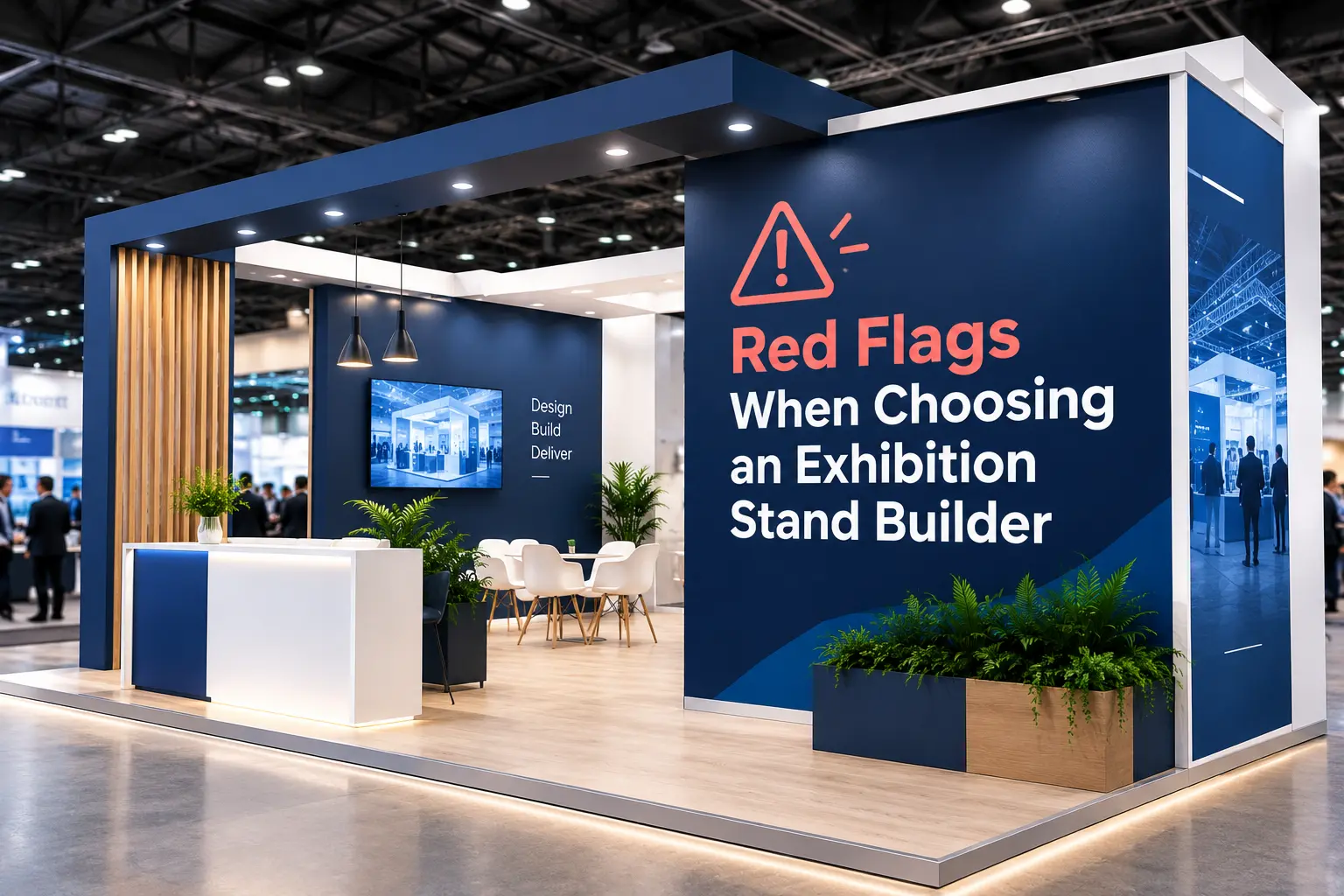
You have paid for the floor space, booked the flights and briefed your sales team. The stand is the one piece of the show that has to be ready on time, on brief and on budget, and it is also the piece you hand to an outside company.
Most exhibitors only learn what a bad builder looks like after move-in day, when the fix is expensive or impossible. The warning signs are almost always visible earlier, in the pitch, the quote and the way a company answers a hard question.
This guide covers ten red flags to watch for when vetting exhibition stand builders, why each one matters, and what to ask instead. Use it as a checklist before you shortlist, and again before you sign.
Renders are easy to produce. Finished stands, photographed on a real show floor, are not.
Be cautious if a builder’s portfolio shows glossy visuals but few or no photos of built stands, or if the same three projects appear everywhere. Ask which stands in the portfolio they physically built, at which shows, and for which clients.
A credible builder will show you completed work across industries and sizes. You can see how BuilderDeck presents this in our portfolio, which covers sectors from solar and materials to jewellery, aviation and consumer electronics.
Ask instead: “Can I speak to a client who exhibited at the same show I am targeting?”
This is the most common hidden risk in the industry. Many exhibition stand contractors sell the project, then outsource fabrication to one vendor, installation to another and electrical work to a third. Every hand-off is a place where quality slips and responsibility goes missing.
If a builder is vague about who cuts the panels, who wires the lighting and who is on site during install, treat that as a warning. Ask for a direct answer: in-house crew, or subcontractors?
Working with a team that owns fabrication and installation, as we do on every bespoke exhibition stand, means one accountable team and no surprise vendors at the venue.
Ask instead: “Which parts of the build are done by your own people, and which are subcontracted?”
A price far below the other bids is rarely a bargain. It usually means something is missing: thinner materials, no lighting, no graphics, no dismantle, no contingency or no freight.
Equally concerning is a one-line quote with a single total. You cannot compare it, and you cannot challenge it when extras appear later. A trustworthy quote breaks out design, fabrication, graphics, AV and electrical, flooring, freight and drayage, installation and dismantle, and permits or venue services.
Logistics is where budgets quietly break. Our breakdown in Drayage, and the Atlantic Gap explains why the same booth can cost very different amounts to move in Las Vegas and in Frankfurt.
Ask instead: “Can you itemise exactly what is and is not included?”
Venues have their own rules on height limits, load-bearing, fire safety, electrical connections, rigging and move-in windows. A builder who has never worked at your venue will learn those rules on your budget and your schedule.
This matters most when you exhibit internationally. A stand that works in one country may need a different approach in another, as we explain in Frankfurt vs Las Vegas Booths: Two Different Projects.
Check whether the builder has on-ground teams or a proven track record where you are exhibiting. BuilderDeck’s worldwide exhibitions page lists the regions and shows we cover.
Ask instead: “How many stands have you built at this venue, and what do you know about its rules?”
Good builders are honest about lead times. If someone promises a fully custom double-decker in a few weeks without asking questions, they are either overpromising or planning to cut corners.
A realistic plan includes time for the brief, concept design, revisions, technical drawings, show organiser approval, fabrication, freight and a pre-build check.
If the schedule has no buffer, a single delay at any stage will land on you.
Our Hannover Messe 2027 planning timeline shows what a workable countdown looks like for a custom stand, and which decisions have to be made early.
Ask instead: “Show me the milestone plan from kickoff to show opening, including approvals.”
If a builder jumps straight to a template, a catalogue or a price, they are selling a product rather than solving your problem. A good stand starts with your goals: the leads you need, the products you must demonstrate, how many meetings you expect and how visitors should move through the space.
Watch for builders who never ask about your audience, your previous show results or your brand guidelines. A stand that looks impressive but ignores traffic flow, storage and meeting space will cost you leads.
Strong design thinking also reflects how visitors really behave. Our notes on the disappearing reception desk show how entry layouts are changing, and Rebrand to Booth Redesign shows how a stand can be rebuilt around a new identity.
Ask instead: “What questions do you need answered about my goals before you design anything?”
You should never approve a stand you cannot see. Reputable builders show you photoreal renders, and for complex builds, technical drawings, before a single panel is cut.
If a builder is reluctant to share visuals, charges heavily for revisions or only shows a rough sketch, you risk a stand that looks different from what you imagined.
Drawings also matter for structural sign-off on larger builds such as two-storey exhibition stands, where load testing and organiser approval are essential.
See how we handle this on our 3D visuals service page.
Ask instead: “What will I see before I approve, and how many revision rounds are included?”
Many show organisers and corporate procurement teams now ask for sustainability evidence. A builder who cannot explain what happens to the stand after the show, or who has no recognised standard, is a growing risk.
Look for certification, a clear reuse approach and honest answers about materials. Be wary of vague claims that rely on a single eco-friendly material. Our guide Beyond the Bamboo separates the choices that really reduce the footprint from the ones that just look good in photos, and ISO 20121 Explained covers what the standard means for exhibitors.
If you exhibit often, reuse also protects your budget. Ask whether the builder offers rental booths or storage and reuse between shows.
Ask instead: “What happens to my stand after the show, and what can be reused?”
The sales stage is the best behaviour you will ever see. If replies are slow, questions get partial answers or you are passed between people with no single contact, expect it to get worse once the build is under pressure.
Good signs include one named project manager, written confirmation of decisions, regular updates and a direct line during show days. Red flags include unanswered emails, changing contacts and no clear escalation route when something goes wrong.
Ask instead: “Who will be my single point of contact, and who covers on show days?”
Read the paperwork before you commit. Warning signs include:
A builder who stays with you through installation, show days and dismantle is far safer than one who disappears after handover. Our about us page explains how a single in-house team stays accountable from first sketch to final dismantle.
Ask instead: “Can I see a sample contract, your insurance and your on-site support plan?”
Before you sign, confirm that the builder can:
If a builder fails more than one or two of these, keep looking.
The right builder also depends on what you are building. A 10×10 inline booth needs different strengths from a large island or a national pavilion. Explore our options by size, from 10×10 and 10×20 up to 20×20, 30×30 and 40×40 trade show booths. For repeat shows and reusable systems, see our modular exhibition stands, and for country or trade-body presences, our pavilion exhibition stands.
Talk to a team that handles design, build, install and dismantle under one roof. Request a quote and a senior designer from the studio closest to your event will respond within one business day, or browse more field notes on the BuilderDeck blog.
Three or four new essays per quarter on design, sustainability, logistics and the trade-show floor. No promos, no calendar spam.
ONE EMAIL PER QUARTER · UNSUBSCRIBE ANY TIME
