
VOL. XII · ISSUE 04 · DESIGN, LEAD
Why GITEX and Big 5 Are Pulling Budget from Europe
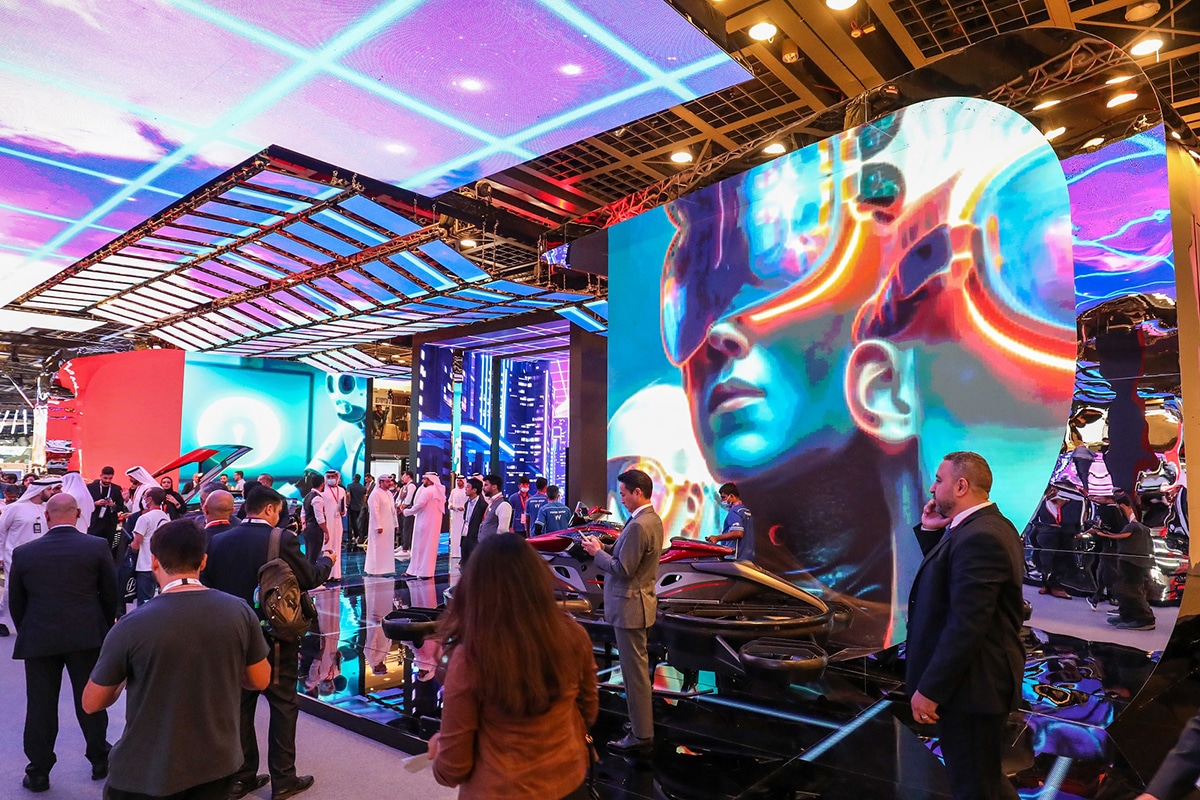
For years, the European calendar set the rhythm for global exhibitors – Hannover Messe for industrial tech, IFA for consumer electronics, a steady circuit of national pavilions built around EU trade policy. That rhythm hasn’t disappeared, but it’s no longer the only one setting the pace. Increasingly, budget that used to default to Europe is being redirected toward Dubai – specifically toward GITEX Global and Big 5 Global, two shows that have grown into genuine gravitational centers for exhibitors across tech, construction, and infrastructure.
This isn’t a minor scheduling shift. It’s a structural one, and it’s worth understanding before your 2027 show calendar and budget get locked in.
GITEX Global has become one of the largest technology exhibitions in the world. The 2026 edition, running December 7–11 at the Dubai Exhibition Centre inside Expo City Dubai, is expected to draw over 200,000 attendees and roughly 6,800 exhibiting companies from more than 180 countries – its first year at the newly expanded venue after decades at the Dubai World Trade Centre. That relocation alone signals how much room organizers believe they need for continued growth.
Big 5 Global, the region’s flagship construction and infrastructure show, runs November 23–26, 2026 at the Dubai World Trade Centre, bringing in an estimated 85,000 attendees and around 2,700 exhibitors from 150+ countries. It’s positioned as the primary gateway into the MEASA (Middle East, Africa, South Asia) construction market – a market with a project pipeline in the trillions of dollars once Saudi Arabia’s giga-projects like NEOM are factored in.
Compare that trajectory to parts of the European exhibition calendar, where several long-running shows have seen flatter or more selective attendance in recent cycles as exhibitors become more deliberate about where they allocate booth budget. The result: a visible reallocation of spend toward shows where buyer concentration, project pipeline, and government-level engagement are growing fastest – and right now, that’s Dubai.
Redirecting budget toward Dubai isn’t simply a matter of swapping one show on the calendar for another. As we covered in Exhibiting Globally and What Changes, moving your exhibition presence between regions changes far more than the destination – labor rules, freight timelines, customs processes, and even standard booth height allowances differ significantly between a European venue and a UAE one. Exhibitors who treat a first GITEX or Big 5 booth like “the same show, different city” are the ones who run into avoidable problems during move-in week.
Shipping is a particular pressure point. The logistics dynamics discussed in Drayage, and the Atlantic Gap apply just as directly to Middle East–bound freight – except the customs clearance and regional freight considerations for Dubai add another layer that a Europe-only shipping plan simply doesn’t need to account for. Getting quotes and confirming a realistic timeline early is even more critical when your exhibit is crossing into a market your logistics team hasn’t shipped into before.
The scale of these shows means booth format decisions carry more weight than they might at a smaller regional event.
For exhibitors making a first appearance at GITEX or Big 5, a fully bespoke structure isn’t always the right starting point. Our Custom Exhibition Stands service supports exhibitors who want a flagship, architecturally distinctive presence from day one – a strong option for companies entering the Middle East market with a major product launch or a clear intent to make Dubai a permanent fixture on their calendar.
For exhibitors testing the market before committing to a full custom build, Modular Exhibition Stands and our Rental Booths service offer a lower-risk way to establish a strong presence at GITEX or Big 5 without the capital commitment of an owned structure – particularly valuable for exhibitors who aren’t yet sure whether this will become a recurring show on their calendar.
Given how large both show floors are, standing out matters even more than usual. Companies looking to command real visual presence often turn to our Double Decker Exhibition Stands service – a second level adds meeting space and VIP hosting capacity without expanding your floor footprint, which matters at a show where prime floor space is, as GITEX exhibitors have found in recent cycles, booked out nearly a year in advance.
And for government bodies, trade associations, or industry consortiums looking to establish a unified national or sector presence at either show, our Pavilion Exhibition Stands service is built specifically for this kind of multi-tenant coordination – a format we’ve seen work particularly well at GITEX, where dozens of countries already field national tech pavilions each year.
Given how far in advance floor space needs to be secured for shows at this scale, our 3D Visuals service lets exhibitors approve a full render, technical drawing set, or VR walkthrough months before a single panel is fabricated – a particularly valuable step when the booth is being designed for a market your team hasn’t exhibited in before, and there’s no opportunity to walk the actual hall ahead of time.
If GITEX or Big 5 earns a permanent slot on your calendar after the first show, our Store & Reuse service becomes the more cost-effective path going forward – refurbishing and redeploying structural elements for each return trip to Dubai rather than rebuilding from scratch, which meaningfully lowers both cost and the shipping burden for exhibitors making this an annual commitment.
Both GITEX and Big 5 draw exhibitors ranging from small startup pavilion tenants to major global brands with island-scale footprints. If you’re still working out what size makes sense for your first appearance, our booth-by-size guides – from 20×20 Trade Show Booths up through 40×40 Trade Show Booths – break down what each footprint realistically supports, which is worth reviewing before committing to a size based on budget alone.
Not every exhibitor should chase the momentum in Dubai simply because the attendance numbers are trending upward. The calculation is different depending on your industry and target buyer:
The honest answer for most global exhibitors isn’t “abandon Europe for Dubai.” It’s recognizing that budget once allocated by habit now needs to be allocated by where the buyers, the capital, and the government engagement actually are – and for a growing number of industries, that answer increasingly points toward the Gulf.
The pull toward GITEX and Big 5 isn’t a passing trend – it’s backed by attendance growth, capital project pipelines, and sustained venue investment that most European shows aren’t currently matching at the same pace. For exhibitors weighing where their 2027 budget should go, the Middle East case is strong enough that it deserves a genuine seat at the planning table, not just a “maybe next year” mention.
Whether that means a first custom stand at GITEX, a modular test run at Big 5, or a full pavilion presence representing your national industry body, the planning window for shows at this scale is longer than most exhibitors expect. If Dubai is on your radar for 2027, get in touch – our teams across the UAE and Europe can help you figure out exactly what that first Middle East show should look like.
Three or four new essays per quarter on design, sustainability, logistics and the trade-show floor. No promos, no calendar spam.
ONE EMAIL PER QUARTER · UNSUBSCRIBE ANY TIME
